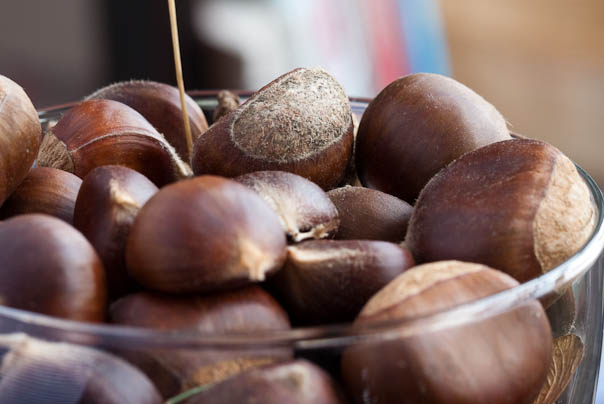
Chestnuts Demystified

chesnuts-091011-0001

Have you ever tasted a chestnut?

If you buy them pre-cooked in jars at the store, they tend to be pricey. I believe I saw some last year for about $10 at wholefoods, and the contents of the jar was probably only about 2/3 cup. That seems prohibitively expensive to me, and so I had never cooked with them.

But then last week at the farmers market, I saw a pint of fresh chestnuts for $4.00. I snatched them up without a real plan for them.

When I got them home, I was like…how am I going to cook these little buggers? “Chestnuts roasting on an open fire?” That sounds a little dicey to me. So I researched a little and decided to peel and boil them.

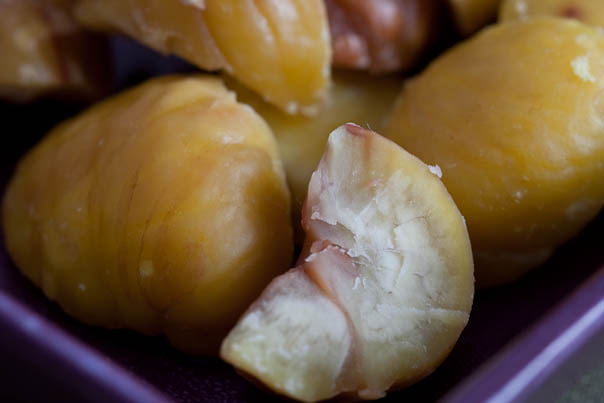
And now I know why they are so expensive in the store…it is definitely a manual process but the taste…oh my goodness, chestnuts are SO supple and delicious with an earthy sweetness. And the texture is unexpectedly soft and creamy, they practically melt on your tongue.

If  you have access to reasonably priced chestnuts–at a market, a store, or if you have a neighbor with a chestnut tree–I recommend trying to cook them yourself at least once. After you taste them, you will know it is worth the effort!

Chestnutschesnuts-091011-0002
Ingredients

  • 1 to 2 cups fresh, raw, in-shell chestnuts
  • Water
  • Salt

Method

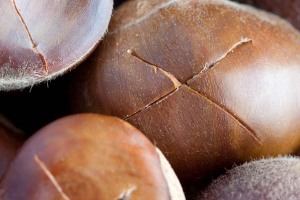
First thing you need to do is get the shell off, and this is a lot easier if you do a quick cook of the nuts first. Put a pot of water on to boil (you only need just enough water to cover your chestnuts by about an inch). Meanwhile, use a paring knife to score the shell with an ‘X.’ Try not to cut too deep into the actual nut when you do this.

Drop scored chestnuts into boiling water, turn the heat down to medium, and simmer for 5 minutes. Turn the heat off, and use a slotted spoon to remove a few chestnuts at a time from the water. They will be very hot, so let them cool for a minute or two before handling. Using your fingers, remove the shell and the fibrous covering over the chestnut. If any shells seem particularly stubborn, return to the hot water for a few more minutes to help loosen them.

TIP: You may find a worm in one or two of your chestnuts. How do they get there? I don’t know. But throw these chestnuts away. You may also find some chestnuts that look kind of black or otherwise “not quite right.” Don’t waste your time on them, just toss ’em and move on. Out of my pint, I probably had to throw away about 8 to 10 chestnuts. But there were still plenty to work with.

BONUS TIP: Removing the shells is the part that is a little tedious, so stream some Hulu or listen to a podcast while you work. :)

Once all your chestnuts are free from their shells, put a fresh pot of water on to boil, season generously with salt. Turn the heat down to medium, add your chestnuts, and simmer until they can be pierced easily with the tip of a knife, about 20-30 minutes depending on the size of the nuts.

Drain, and allow to cool. These will keep in the refrigerator for a little over a week.

Stay tuned for ways to use your delicious chestnuts!
chesnuts-091017-0003

Spicy Roasted Pumpkin Seeds

pumpkin-seeds-091011-0004
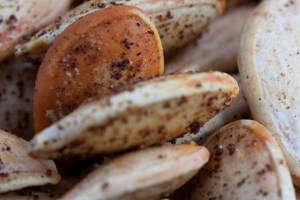
It’s that time of year…everyone I know is cracking open pumpkins and carving them into spooky visages. This was a favorite ritual of mine as a kid, and one of the best parts about carving a pumpkin is the gorgeous seeds that are harvested from the innards. I remember trying to roast the seeds once or twice as a kid; I didn’t really know the best way to go about it and I ended up with burned, salty, unpleasantly chewy bits. But I didn’t know better so I ate them anyways.pumpkin-seeds-091010-0002

I forgot all about roasted pumpkin seeds until last year when I went to make a vegan pumpkin pie. I got a fresh pie pumpkin from the farmers market, and pulled out the seeds. I hate to throw anything away, so I did a little research on the best way to roast the seeds. Of course I had to give it my own twist and up the ante with a little kick.

These are the perfect pumpkin seeds. They are crisp and crunchy, and the spices really make them something special. My husband actually thinks they taste a little like bacon bits, but neither of us has had bacon in years, so I think he is saying that because of the combination of salt and crunch.

One of my favorite things about this recipe is listening to the crackling of the pumpkin seeds as they’re cooling; for some reason it is a very satisfying sound.

TIP: If you don’t have fresh pumpkin on hand, you can always buy your pumpkin seeds online.

Spicy Roasted Pumpkin Seeds

Ingredients

pumpkin-seeds-091011-0003

  • 4 cups pumpkin seeds, washed and squeaky clean
  • 4 tablespoons salt
  • 2 tablespoons olive or canola oil
  • cooking spray
  • spice mixture (see below)

Method

Preheat your oven to 400°F, and adjust your oven racks to accommodate 2 cookie sheets.

Put a large pot of water on to boil (around 4 quarts water). Put the salt into the water.

When the water is at a rolling boil, add pumpkin seeds and boil for 10 minutes, stirring occasionally.

Meanwhile, brush a tablespoon of oil onto each of your cookie sheets.

When time is up, drain pumpkin seeds and transfer to your lubed cookie sheets. Give them a stir to coat them with some of the oil, then spread them out into a single layer on each sheet. Pop the cookie sheets into your hot oven for 20 minutes. When time is up, pull the cookie sheets out one at a time, stir the seeds, and redistribute into a single layer. Rotate cookie sheets, and cook for another 20 minutes. The seeds will start to crack and pop and jump in the oven. Enjoy the show.

When time is up, remove cookie sheets from oven, turn off the oven heat, but close the door to keep as much heat in the oven as possible. Working quickly, spray each sheet with cooking spray, and then dust generously with the spice mixture. Stir the seeds, repeat one more time with cooking spray and seasoning, and then spread them back out into a single layer on each sheet. Return to the hot oven for 5 minutes. Remove the pans from the oven and let cool completely before eating.

Note: If the oven is still roaring hot, the spices that are left on the pan may produce a little smoke; but if so, don’t worry about it, that will actually add to the flavor.

Spice Mixture

  • 1 teaspoon chili powder
  • 1 tablespoon paprika
  • 1 tablespoon ground cumin
  • 1/4 teaspoon cayenne pepper
  • 1 teaspoon fine sea salt (or table salt)

Combine all ingredients in a small jar, an empty spice jar would be ideal. Shake to combine.

Here is where you can really get creative with this. Add some turmeric, play around with the heat by adjusting the cayenne, reduce the cumin, or add some crushed thyme or oregano. It’s up to you! Make it the way you like it.

pumpkin-seeds-091010-0001

Little Tomato, Garlic, and Basil Salad

tomato-091002-0001Tomato season is almost over! We might have one more good week left here on the mid-Atlantic east coast before it’s gone.

This makes me sad. But fortunately for me, it’s been a great season for tomatoes.

tomato-091002-0003

And fortunately for me, I’ve been getting these lovely bags of tomatoes the past few weeks from my CSA. There have been abundant heirlooms, romas, beefsteaks, cherry, and pear tomatoes. They have all been amazing, but it’s these little bitty cherry and pear tomatoes that really inspire me.

They have been showing up in mouth-watering shades of red, yellow, orange, and tiger striped. They are intensely sweet and delicious; I’d have to say that on the Tomato Flavor Scale™ of one to ten, these go to eleven. I love to eat them plain, but mixing them with a few other ingredients out of my CSA delivery really brings up their flavor.

tomato-091002-0002

When I make this little salad, I tend to just leave it out on the counter and snack on on it as the mood strikes. Taking a few minutes to treat your tomatoes this way also makes them great to use for pizza topping or in wraps.

Also, I think it pays to take the time to chop your garlic by hand for this one. The texture and appearance is better than pressing it. It won’t take too much time to do this, I promise…it’s just one clove!

Trust me, your taste buds will thank you…

Tip: If you weren’t already aware, you should store your tomatoes at room temperature whenever possible for best flavor and texture.


Little Tomato, Garlic, and Basil Salad

Ingredients

tomato-091002-0004

  • 1 generous pint cherry, pear, or small roma tomaotes
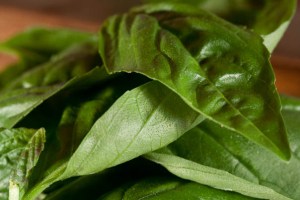
  • 1 generous handful basil
  • 1 large clove of garlic
  • Red wine vinegar
  • Salt & pepper, to taste
  • Olive oil (optional)

Method

Quarter your little tomatoes and put them in a bowl (romas may need to be cut into smaller pieces). Sprinkle with a generous pinch of salt to start pulling out some of the juices.

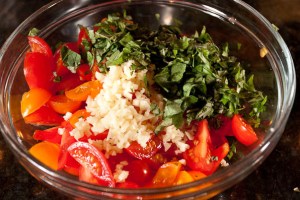
Chop your basil and mince your garlic, and add it to the bowl. Give the whole thing a splash of red wine vinegar, a splash of olive oil (if using), and a grind of pepper. Toss to combine, taste for seasoning and add a little more salt if necessary.

Let the mixture sit in its own juices on the counter for about 30 minutes, if you can wait that long. (I often cannot!)

When ready to use, strain out the juices and set aside. Enjoy your tomatoes at room temperature.

tomato-091002-0001-2Tip: You can also add a few other things to play with the flavors here. I’ve tried this with different combinations of herbs, including parsley and mint. I’ve also tossed in some diced roasted red pepper when I’ve had it on hand, and a little diced jalapeno for some kick.
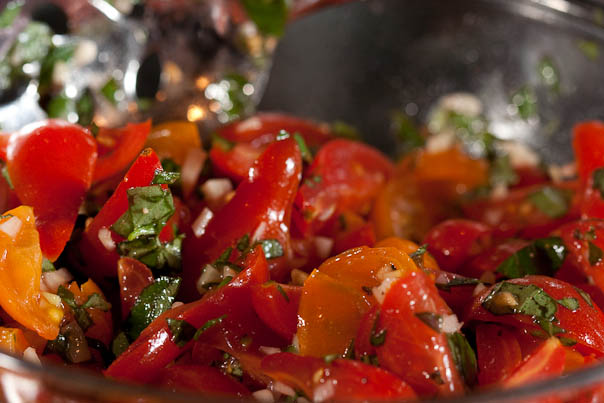
BONUS TIP: Don’t throw away that liquid once you’ve strained your tomatoes! Everything that has been sitting in the bowl and marinating has given some flavor to that juice. You can use the liquid to replace some or all of the cooking liquid in your pizza dough or a savory bread. Use it to make a light salad dressing. Or add it to your next batch of soup or stock. If you don’t think you’ll use it right away, freeze it and it will be ready when you are.

tomato-091002-0005

Beans

beans-091002-0002Let’s talk beans.

I am a super cheapskate when it comes to some things. For example, I absolutely hate buying bread because basically all it consists of is flour, water, yeast, a tiny amount of sugar and salt, and those things are so cheap to buy! I’d rather make my own for various reasons, but the major problem I run into constantly is that bread takes a lot of time and attention, so sometimes when I am really busy I have to suck it up and just go buy a loaf.

Beans are another category of food where I am super cheap. Canned beans are expensive, tend to be high in sodium, and they are also super heavy to carry home; however, dried beans are $cheap$ and easy to use, take up less room in the cupboard, require less packaging, and buying them in quantity generally doesn’t make your arms feel like they are going to fall off when you are trying to only make just one trip from the car to the front door after grocery shopping. Again, they take time, but unlike bread, they do not have to be watched or pampered.

Cooking Beans

Using dried beans does require a certain amount of calculation though, to make sure that you end up with the amount that you need once they are soaked and cooked. Dried beans tend to plump up by a factor of 3, so as a basic rule of thumb, if you need 3 cups of cooked beans for a recipe, then you need to start with one cup of dried.

I have found that with smaller beans (like navy beans), they cook up to slightly less than 3 times their original size, so I usually add a few extra dry beans to account for that.

Some useful numbers, pulled from http://www.centralbean.com:

  • One 15-ounce can of beans = one and one-half cups cooked beans, drained
  • One pound dry beans = six cups cooked beans, drained.
  • One pound dry beans = two cups dry beans.
  • One cup dry beans = three cups cooked beans, drained.
  • Use 3 cups of water per cup of dry beans for soaking.

YOU MUST SOAK YOUR BEANS BEFORE COOKING!

The longer you soak, the less cooking time they will need, and the less potentially gassy you will be upon eating them. Soaking overnight generally means about an hour of cooking time.

You can also do the quicker method, which is to boil the beans for one minute, soak for one hour, then cook for an hour.

Always discard the soaking water, rinse the beans, and cook with fresh water.

When cooking beans, do not leave the water at a rolling boil or your beans will bash into each other in the pot, their skins will come off, and they will not look as pretty. The way to do it is to initially bring the water to a boil, then turn the heat down to a simmer.

Add about a teaspoon or more of salt to the cooking water, and also a tiny bit of oil. You can also tuck a bay leaf or two into the water.

beans-091002-0001Useful Tools

A pressure cooker is a great tool to have if you cook a lot of beans. I use mine almost exclusively for beans because it is so quick. Once the pot comes up to pressure, I can cook a load of pre-soaked garbonzo beans in about 10-13 minutes; smaller beans can take as short as 7 minutes. If you have a pressure cooker, check your manual for instructions.

A slow cooker is also really great and produces beans with superior flavor and almost zero fuss. Slow cookers vary widely so definitely read your manual.

Storing Cooked Beans

If you are going to go to the trouble to soak and cook beans, why not make a big batch and stash some away for future use? If you know you are going to use your beans in about a week or so, you can store them right in the fridge. But for longer-term storage, cover them with water and freeze them in small batches so that you can pull out and thaw just the right amount when you are ready to use them.

Nutrition

Beans are high in protein and fiber, have zero cholesterol, and provide essential vitamins and minerals. They are also relatively low in fat and calories.

Really, when you think about it…beans are great! And there are so many varieties to choose from. What’s not to love!

Happy Road Fudge

lemon-091004-0003Fudge. Vegan fudge. Vegan fudge that I fed to mixed company today, and which made everyone squeal with chocolatey delight. No one said, “I can’t believe this is vegan!” They just smiled happily as they tucked away piece after piece. Except for Michelle, who called my fudge stupid because she couldn’t stop eating it, despite her diet.

This recipe is modified from an America’s Test Kitchen recipe. Theirs is called Rocky Road. Mine is called Happy Road.

It keeps well in the fridge for up to a week, although you will probably notice that by the end of the week, the texture changes somewhat. It becomes a little denser and the marshmallows are a little less springy. But who am I kidding…it is so good that you won’t have any left by the end of the week anyways! So it is kind of a moot point.
lemon-091003-0002

Happy Road Fudge

Ingredients

  • vegan shortening (or margarine), for greasing
  • 2 tablespoon non-dairy milk
  • 1 tablespoon arrowroot powder
  • 1 1/4 cup non-dairy creamer (I like MimicCream for this but have used others as well)
  • 1/4 cup plus 2 tablespoon corn syrup (or agave nectar or simple syrup)
  • 16 ounces dairy-free semisweet chocolate , chopped fine
  • 2 ounces unsweetened chocolate , chopped fine
  • 1/2 teaspoon baking soda
  • 1/8 teaspoon table salt
  • 1 tablespoon vanilla extract
  • 1 teaspoon chocolate extract (optional)
  • 1 cup vegan marshmallows, chopped into small pieces (I like Sweet and Sara)
  • extra powdered sugar (optional, for working with vegan marshmallows which can be sticky business)
  • 1 cup chopped salted peanuts
  • 1/2 cup dairy-free semisweet chocolate chips

Put a pot of water on to simmer with 1-2 cups water.

Line an 8 inch square baking dish with foil, and use vegan shortening to generously grease the sides.

Whisk arrowroot powder into soy milk thoroughly, and set aside.

Toss chocolates, baking soda, and salt in medium heatproof bowl until baking soda is evenly distributed.

In a small saucepan, heat soy creamer and corn syrup until it just begins to boil. Remove from the heat and whisk in the arrowroot/soy milk slurry. The mixture will thicken a touch. Pour over chocolate.

Whisk soy milk/creamer mixture, vanilla, and chocolate extract (if using) into chocolate, and set bowl over the saucepan containing simmering water. Stir with rubber spatula until chocolate is almost fully melted and few small pieces remain, 2 to 4 minutes.

Remove bowl from heat and continue to stir until chocolate is fully melted and mixture is smooth, about 2 minutes. Fold in marshmallows, peanuts, and chocolate chips. Transfer fudge to prepared pan and spread in even layer with spatula. Refrigerate until set, about 2 hours. Remove fudge from pan and remove foil. Cut into squares. To cut nice neat squares, keep a clean damp dishtowel or paper towel handy and clean the knife before each cut.

Anything that doesn’t get eaten right away can be stored in the refrigerator. Use wax paper between layers to keep the fudge from sticking to itself, and enjoy within one week.

lemon-091003-0001

Lemon Ginger Tea

lemon-090930-0002Lemons are really wonderful. No one would ever sit down and eat a lemon or drink a glass of straight lemon juice unless it was for a dare. But added to food and drinks, lemon brings an amazing brightness and pleasant acidity to many foods, both savory and sweet.

But when using lemon, there is a dark side of which we must be careful. It is….BOTTLED LEMON JUICE.amcor_cliffstar_lemon_juice

Oof, I shiver just to look at it.

Let’s consider bottled lemon juice for a moment…have you ever tasted the stuff straight out of the bottle? And then tasted a real lemon? They don’t taste remotely alike. It’s like bottled met fresh at a party once, and that’s all they have in common. Bottled just tastes kinda dead, and it certainly isn’t doing your food any favors either.

To be fair, there is one thing that bottled juice is good for, and that is canning tomatoes and tomato products (which I will discuss in another post). But if you don’t can, then you don’t need it.

Juicing lemons takes hardly any time at all, and it will really elevate the flavor of your food if you’re not already using fresh juice; this is a case where the effort is more than worth the return.

No special equipment is needed, you can juice lemons with a fork over a bowl if you want to. But if you’re going to take the plunge, I recommend splurging on a reamer that sits above a measuring cup (such as this one from oxo), which is actually really handy for juicing any citrus fruits.

You will notice that in all my recipes, I stress that you must use fresh lemon juice. Now you know why. There are certain foods that I make and take to parties with me that always have people asking me “what’s the secret?” Now you know the secret.

So let’s jump in and make something that really showcases fresh lemon juice: my favorite tea.

Technically, this is an “infusion” and not tea. It is inspired by a drink I used to order in the Bookworm Cafe on Lamma Island when I lived in Hong Kong. It is really versatile and the quantities can be liberally adjusted to suite your taste.

lemon-090930-0001-2

Lemon Ginger Tea

Ingredients

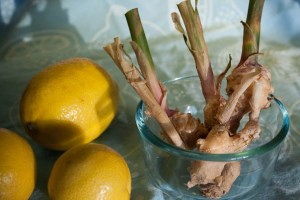
  • a 3″ piece of ginger root
  • 2-3 lemons, juiced
  • 1 quart boiling water
  • 2 tablespoons agave nectar

Method

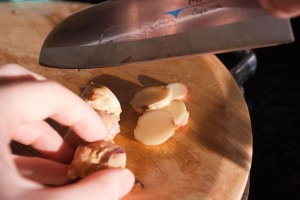
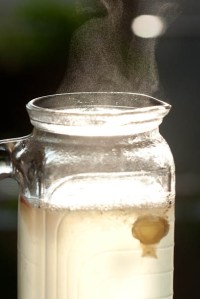
Give the ginger a good scrub under running water (I don’t usually even bother to peel it). Slice it into thin coins, and place into a tea pot or pitcher. Add lemon juice, boiling water, and agave nectar. Stir to combine, and let steep.

The amount of time you let the tea steep will affect how spicy it gets from the ginger…longer time means spicier. I really like the kick of ginger so I tend to let it sit for quite a while before drinking.

Taste the tea and adjust the sweetness and acidity as desired but playing with the agave and lemon juice.

Serve hot OR over ice. It’s delicious both ways.

lemon-090930-0003lemon-090930-0005
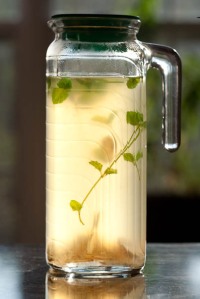
TIP: If you’re really feeling saucy, how about adding some fresh mint as well?

lemon-090930-0007

Simple Savory Avocado

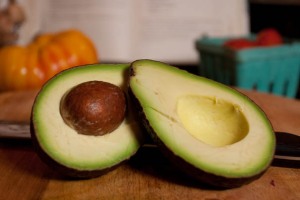
food-090930-0003Avocados were not a food that I grew up eating. In fact, I don’t think that I even tasted an avocado until well into my 20s. I wish I could remember the first time my face encountered a perfectly ripe avocado’s rich, velvety smoothness and clean taste, which has now become something I absolutely adore.

While guacamole is a pretty well-known and DELICIOUS way to serve avocados, I also like them more simply done up: they really come into their own when roughly chopped and sprinkled over a hot bowl of chili, sliced thin and laid out over a veggie pizza in lieu of cheese, or mashed into some crusty grilled bread with just a pinch of coarse sea salt.

food-090930-0004

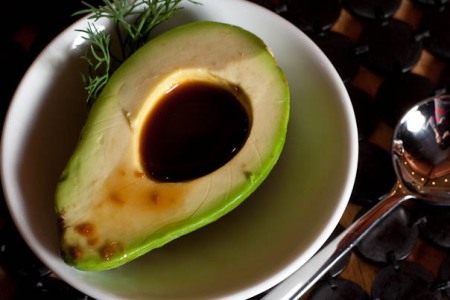
One of my favorite ways to serve avocados is this easy dish. It takes just a few minutes to prepare (you could probably even get to sub-minute times if you really practiced) and the dressing can be made days in advance.

You can make your own variation by subbing in ginger, or another kind of vinegar, or some hot sauce. No matter how you go about it, this is a really impressive way to showcase any creamy ripe avocados you can get your mitts on. I like to make up the dressing and keep it in the fridge, so that I can pull it out and splash it over avocado halves as the mood strikes. You really couldn’t ask for a quicker, more elegant, or more satisfying small dish.

TIP: If your avocados are hard when you buy them, leave them on the counter for a day or two until they yield slightly to gentle pressure. They should retain some firmness and NOT feel squishy. As soon as you think you’ve got one at the height of its ripeness, you can toss it into the fridge for a few days to halt the process so that it will stay perfect until you need it. I actually prefer to buy my avocados on the hard side so that I can control how soft they get before they make it onto my plate.

food-090930-0006

Simple Savory Avocado

Ingredients

  • Juice of one lemon (you MUST use fresh)
  • 2 tablespoons soy sauce or tamari
  • 1 tablespoon balsamic vinegar
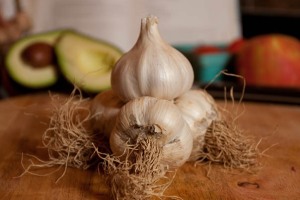
  • 1 garlic clove, pressed or minced
  • Ripe avocados

Method

Prepare the dressing first. Combine the lemon juice, soy sauce, vinegar, and garlic in a small jar (or bowl). Shake (or whisk) to combine. Use immediately or cover and refrigerate for up to a week.

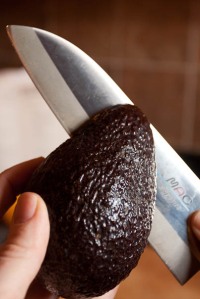
When ready to serve, halve, pit, and peel your avocados. Place in a bowl or on a platter, drizzle with the dressing, and garnish as desired (chopped parsley or a sprig dill are nice). Enjoy right away!

food-090930-0002